
Star Catcher’s Laser Power Beaming Tech Is Poised to Unlock a New Era of Orbital Industrialization
Everyone from Google and SpaceX to a fast-growing cohort of aerospace startups has laid out plans to build orbital data centers in coming years — but every one of these ambitious projects shares a non-negotiable, unmet requirement: massive amounts of readily available off-world power.
Jacksonville, Florida-based startup Star Catcher is positioning itself to fill that gap, with a system that concentrates harvested solar energy and transmits it via targeted lasers to waiting solar panels on client satellites. The firm is gearing up to launch its full prototype system on an upcoming SpaceX rocket this week, for a test that will beam power to a separate unrelated satellite in orbit. If successful, it will mark the first time in history that lasers have transmitted usable energy between two untethered, free-flying objects in space.
A Decades-Old Idea Finally Made Feasible
The core concept of space-based solar power is far from new: it first appeared in a 1941 Isaac Asimov science fiction story, and NASA ran formal research programs exploring the technology all the way back in the 1970s.
“At the time, launching large volumes of heavy hardware to orbit was prohibitively expensive, so building space-based power generation infrastructure to transmit energy elsewhere never made practical economic sense,” explains Hanieh Fattahi, a researcher at the Max Planck Institute for the Science of Light.
Steadily plummeting launch costs over the last decade have changed that math entirely, making orbital industrialization a tangible near-term goal. “There’s no functional power grid in space right now,” notes Andrew Rush, Star Catcher’s CEO and co-founder. “Every satellite is essentially running its own tiny, self-contained power setup, like people on independent backcountry camping trips with no shared utility lines.”
How Star Catcher’s Laser Power Network Works
Star Catcher’s solution is a constellation of orbital units it calls “power nodes”, which operate as both space-based solar power plants and wireless high-voltage transmission lines. Each satellite uses an array of specialized lenses to collect raw sunlight, then refines that light to a narrow optimized wavelength the company claims delivers up to 10 times the power density of unfiltered diffuse sunlight. That concentrated energy is then emitted as a directed, steerable laser beam — acting as an ethereal, wireless transmission cable that can be targeted at any satellite in need of extra power.
The system promises far longer operational uptime for satellite operators, which Rush notes directly translates to higher profit margins. In an industry where launch costs run into thousands of dollars per kilogram of payload mass, shrinking heavy, bulky on-board batteries to free up room for more mission-critical hardware — from extra GPUs for space data centers to high-resolution sensors for observation craft — delivers massive return on investment for operators.
The market has already shown clear enthusiasm for Star Catcher’s offering: the firm closed a $65 million funding round earlier this year, won a $30 million development award from the U.S. Space Force, secured 40 letters of intent from prospective customers, and locked in 10 long-term binding power purchase agreements. Notably, Google’s very first test space data center payload is also hitching a ride on the same SpaceX rocket carrying Star Catcher’s prototype this week, a clear signal of existing demand for the off-world power the startup aims to provide.
Testing the Concept, and Charting the Path Forward
The small test satellite launching this week, dubbed Protostar, is a scaled-down demonstration of the full commercial satellites Star Catcher plans to deploy later in the decade. Rush says the final constellation will be able to deliver “meaningful, commercially viable power provisioning services to customers in orbit before the end of the 2020s.” This week’s trial will mark the first time the full end-to-end system operates in space: the team will use their precision tracking technology to beam energy to a separate co-launched cubesat, measuring exactly how much power the cubesat receives as it drifts away from Protostar, and comparing real-world performance against their pre-launch models.
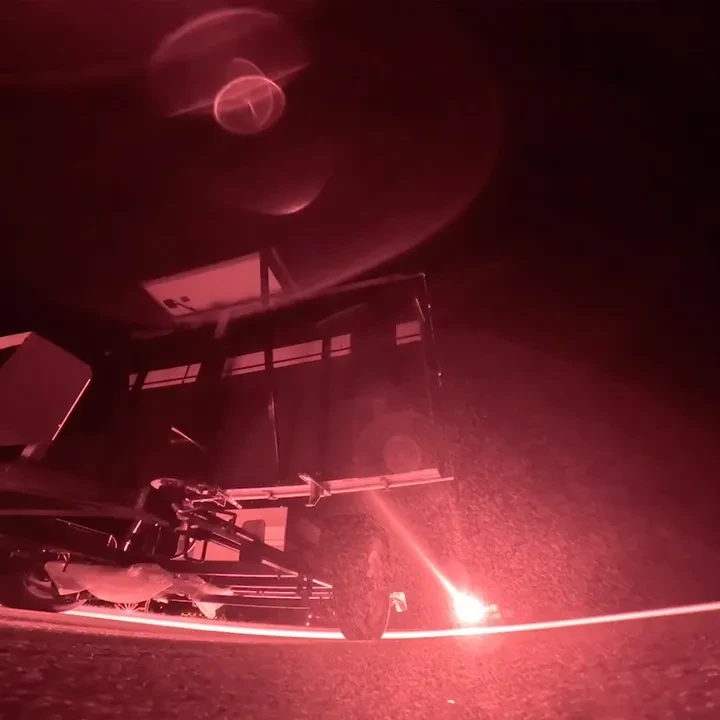
Star Catcher has already completed separate in-space tests of its satellite tracking technology, and last year set a new terrestrial power-beaming record, outperforming a prior benchmark set by DARPA. That ground test delivered over 1 kilowatt of usable power directly to off-the-shelf consumer solar panels — enough electricity to run a standard household microwave.
While that output is still far below the level needed to power large telecommunications satellites, let alone full space-based data centers, Rush says the successful ground proof of concept gives him full confidence their system will perform as expected in orbit. He notes the company is still firmly in the “crawl” phase of development, on track to progress to walking, then running at full commercial scale.
For context, the 2023 U.S. Naval Research Laboratory space laser power experiment ran for 100 days, but operated as a single integrated unit, with its transmitted beam traveling less than 5 feet. “If Star Catcher is at the crawling stage right now, that 2023 test was equivalent to a baby’s tummy time,” Rush jokes. Fattahi adds that plenty of engineering hurdles still remain: the 2023 NRL test only hit 11% energy efficiency, a gap that will need to be closed, alongside solving long-range precision tracking, consistent thermal management, and multi-year hardware reliability in the harsh cold vacuum of space to make space-based laser power commercially viable.
Other research teams have explored alternative space-based solar approaches, including a successful Caltech test that transmitted solar power back to Earth via microwaves. That technology can move higher volumes of total energy, but requires enormous, massive receivers to capture the output, while targeted lasers can hit tiny, lightweight satellite solar panels with far greater accuracy and far less wasted energy.
“As we expand this power infrastructure in space,” Rush says of Star Catcher’s coming constellation, “we will make it dramatically more economical to deploy larger, higher-capability industrial assets off-world. I see the system we are building as just as transformative for the space sector as reusable orbital launch vehicles were.”