
This feature was originally published on Vox, as part of the Climate Desk collaborative journalism initiative.
The Hidden Twilight Reefs of the Pacific: Unlocking the Ocean’s Most Underrated Scientific Puzzle
On a sun-dappled May day last year, I stood on the deck of a small research boat bobbing in the bright turquoise waters surrounding Palau, a tiny island nation in the Western Pacific. I was there to observe a team of scuba divers prepping to pull up physical evidence of a little-documented, almost mythic underwater world that sits just out of reach of casual snorkelers and most standard research expeditions.
Palau is world-renowned for its vibrant, sprawling shallow coral reefs that draw divers and conservationists from across the globe. But the team I was with had no intention of stopping at those sunlit, well-studied shallow communities. They were gearing up to dive far past that line, into a little-known dim zone called the mesophotic coral ecosystem — often shortened to "deep reefs" for simplicity, a stretch of ocean spanning 30 to 150 meters below the surface where sunlight fades to a soft glow, and total, inky darkness hasn’t yet set in.
A world almost entirely unaccounted for
Leading the dive team was Luiz Rocha, zoologist and curator at the California Academy of Sciences, who has spent decades chasing the secrets of these little-explored deep reef systems.
“Anything between 30 meters and 150 meters is really, really unknown,” he told me.
That massive knowledge gap leaves researchers like Rocha working from scratch to answer even the most basic questions about how these ecosystems function. Right now, their top priority is establishing a biodiversity baseline: first, simply mapping what species live there, before they can move on to testing longstanding theories about whether deep reefs might act as a safe climate refuge for stressed species that are currently dying off in warmer, bleaching-prone shallow reefs.
Nearly every published paper on mesophotic ecosystems notes how little data scientists currently hold. A 2019 report from the US National Oceanic and Atmospheric Administration is filled with tentative qualifiers, noting that deep reefs may act as critical protected habitat for dozens of ecologically and economically important fish species, among other unconfirmed roles.
Researchers do know a handful of core facts for certain: deep reefs appear alongside shallow reefs across most tropical and subtropical regions of the planet, from Micronesia to the Caribbean to the Gulf of Mexico. Many of their resident species are found nowhere else on Earth, and recent early studies suggest they are far more vulnerable to ocean warming and acidification than previously assumed.
They also operate on fundamentally different biological rules than their shallow counterparts. Near the surface, hard corals rely on symbiotic photosynthetic algae that share nutrients with their coral hosts, who in turn secrete the calcium carbonate that builds the reef’s physical structure. At 30 meters and below, light levels plummet to make photosynthesis far harder, temperatures drop significantly, and all resident species have adapted to survive in that dimmer, cooler, far less energetic environment.
The extreme challenges of exploring deep reefs
Even for veteran divers like Rocha, doing field work at 100 meters is incredibly difficult and high risk. The deeper a diver goes, the faster nitrogen and other gases are forced into their body tissues, creating hard limits on how much time they can spend at depth, and how quickly they can return to the surface to avoid life-threatening decompression sickness.
“We have a very, very short time at those depths,” Rocha explains. “And by short time, I mean five minutes. Six, seven minutes, max.”
That 7 minute window is barely enough time to snap a few photos, collect a couple of samples, and start the hours-long slow ascent back to the surface. Standard remote operated vehicles and submersibles have been used to survey deep reefs too, but they are extremely expensive to deploy, and their cameras often fail to capture the full diversity of tiny, cryptic, shy organisms that make up the majority of the deep reef food web.
The result is massive, persistent gaps in scientific data.
“Whenever we go somewhere new, the very first thing we find is new species. That’s the most basic, beginner-level discovery you can make in this field.”
Rocha’s goals go far beyond just cataloging new species of fish, sponges, or colorful sea slugs, though. He and his team are chasing fundamental, unanswered questions: what is the primary energy source powering the entire ecosystem in that dim light? What does the food web look like? How are species adapted to these depths different from their shallow-water relatives? How will climate change hit these reefs, and what policies will best protect them?
“In some ways, we don’t even know what questions we should be asking yet. We only identify the most critical research priorities once we have a full baseline understanding of the ecosystem. And for deep reefs, we don’t have that baseline yet.”
The low-tech trick that changed deep reef research
Nearly a decade ago, Rocha stumbled on a surprisingly elegant workaround for the limits of short dives and expensive submersibles: a standardized sampling tool called the Autonomous Reef Monitoring Structure, or ARMS.
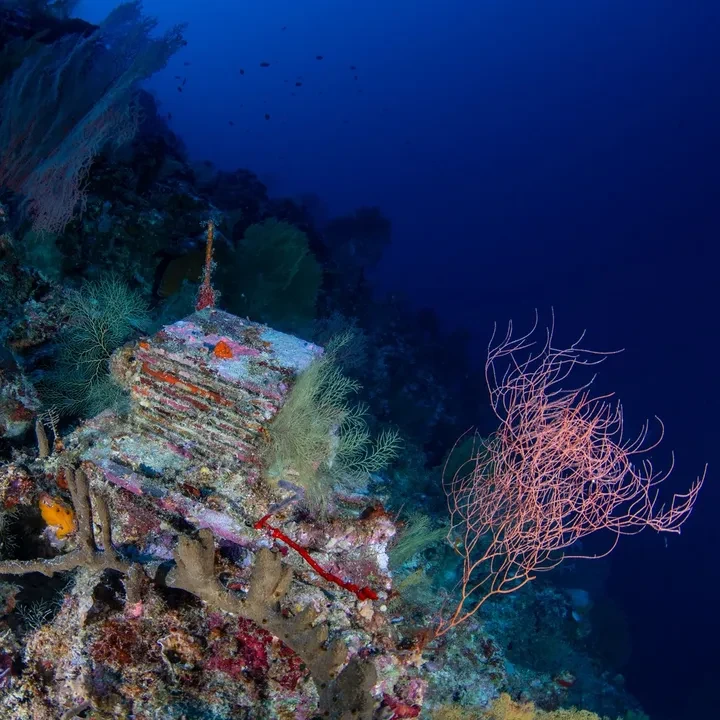
Each ARMS is nothing more than a stack of evenly spaced gray PVC plates mounted to a solid base, designed to look like a tiny, featureless underwater apartment building. Researchers drop them at their target site, secure them to the reef floor, and leave them for years at a time to let local marine life colonize every crevice.
“As soon as you place any clean new structure on a reef, it immediately gets covered in larvae from every organism in the area — sponges, gorgonians, corals,” Rocha says. “The gaps between the plates, the ‘floors’ of that little hotel, then fill up with shrimp, mollusks, sea squirts, every kind of small ocean creature you can imagine. It grows into a stable, diverse mini reef packed with biodiversity that would be almost impossible to collect all at once on a regular dive.”
When researchers return years later to retrieve the ARMS, they can bring the full mini-reef back to the lab to sort, sample, and analyze at their leisure. Unlike random encrusted rocks that researchers might pull from a reef, every ARMS is built exactly the same, which makes it easy to compare biodiversity data across reefs, depths, and entire ocean regions.
“Every single one is identical,” Chris Meyer, director of the Smithsonian’s Global ARMS program, told me. “They’re prefab housing, and you just wait to see who moves in.”
Rocha saw this as the perfect way to get long, unbroken observations of deep reef life, instead of the 5 minute snapshots he could get on dives. Deployment was also extremely low cost, so between 2016 and 2018, he and his team placed dozens of ARMS across reef sites in Palau, Guam, the Marshall Islands, and French Polynesia, at depths of 10 meters, 50 meters, and 100 meters to make direct comparisons between shallow and deep reef communities. They ended up waiting far longer than planned to retrieve them, however, as they spent years securing separate funding for the costly recovery expeditions.
Pulling up Palau’s 7-year-old underwater time capsules
When the team finally returned to Palau to collect their ARMS, the structures ranged from relatively sparse to completely coated in fuzzy, vibrant layers of red, orange, green, and pink marine life. Some held massive, bulky sponges, others dangled with delicate fern-like soft coral fronds. Every recovered ARMS was placed in a sealed bin of seawater and rushed back to the Palau International Coral Reef Center, where the team ran a chaotic, Cheez-It fueled assembly line to dismantle the plates and document every organism growing on them.
Meyer shot high resolution photos of each intact plate, framing them as perfect time capsules of the deep reef community. The rest of the team sorted through trays of debris hunting for tiny crabs, worms, and mollusks, scraped tissue samples into DNA vials, and documented every unique morphospecies, or distinct visible organism, they found. Nudibranch (colorful sea slug) expert Terry Goslinger of the California Academy of Sciences was even able to spot multiple likely new species to science on site, pending DNA testing to confirm their novelty.
Months later, the team is still processing nearly 3,000 collected specimens. So far, only 3% of samples have been identified down to the species level, and less than 20% have been assigned a confirmed genus — the vast majority are only categorized at very broad, high-level taxonomic groups. For Rocha and the team, however, the most valuable finds are not just new species: they are the symbiotic, interconnected relationships between creatures that the full mini-reef ARMS system captures perfectly. On my last evening in the lab, the team stayed up past midnight to point out tiny bright yellow pompom crabs that hold purple anemones in their claws, stick-insect-like skeleton shrimp camouflaged on hydroid branches, and matching pairs of bright red sea snails that live exclusively on the equally bright red soft octocorals they feed on.
Leaving puzzle pieces for the next generation
Rocha often compares the ongoing ARMS project to the early mountain ecology surveys of the mid-20th century, which first mapped how species diversity and composition changes at different elevations as you climb a mountain. That analogy makes clear just how far deep reef research lags behind the far more established field of shallow coral reef ecology.
When I asked him what keeps him working on such a slow, difficult research puzzle, he laughed.
“It’s the reward at the end of it. The harder the puzzle, the bigger the payoff when you start putting pieces together. But we will never fully assemble this entire deep reef puzzle in our lifetimes. We won’t finish the whole thing — but we’ll generate a whole set of really good, high-quality puzzle pieces that the next generation of researchers can use to build the full picture.”