
NASA Unveils 800GB of Public Artemis II Deep Space Scientific Data, First Human-Operated Lunar Dataset in 50+ Years
NASA has just released a 800+ gigabyte public archive of raw, crew-collected scientific data from the historic Artemis II circumlunar mission, marking the first full set of human-gathered planetary science observations captured outside of low Earth orbit shared with the public in more than half a century.
The sprawling archive documenting the four Artemis II astronauts’ trip around the far side of the moon holds 11,000 full-resolution images and video clips, 8.5 hours of unscripted in-flight spoken observations, handwritten crew field notes, full mission transcripts, and imagery captured by every camera mounted aboard the Orion capsule. The last comparable corpus of human-collected lunar science data dates back entirely to the 1960s and 70s Apollo surface missions.
Alongside the near-terabyte raw data dump, NASA also published three curated summary resources for the research community: the Artemis II Preliminary Lunar Science Report, the Artemis II Lunar Science Operations Report, and the official Artemis II Lunar Science Data User Guide. While the full release is primarily targeted at professional researchers, every member of the public can access and explore the full dataset for free.
The archive caters to a wide cross-section of specialist fields, including planetary geologists mapping uncharacterized lunar surface formations, aerospace flight engineers refining deep space navigation systems, heliophysicists studying solar particle behavior beyond Earth’s magnetosphere, telecommunications and remote sensing experts, and researchers modeling meteoroid impact risk for future lunar outposts. For casual space and astronomy enthusiasts, the most approachable assets include full verbatim mission transcripts and lunar landscape photos annotated directly by the Artemis II astronauts with their real-time on-orbit observations.
NASA has centralized all raw scientific files and their accompanying metadata in its long-running Planetary Data System, the permanent public repository for all of the agency’s deep space mission holdings. Visitors can navigate to the system’s dedicated lunar section to pull up the full Artemis II collection and browse every available file, document, and media bundle. For a less technical exploration experience, the agency also hosts a dedicated public Artemis II science page, where users can download the three summary reports, browse a curated gallery of high-quality mission photography, and access the full mission audio library.
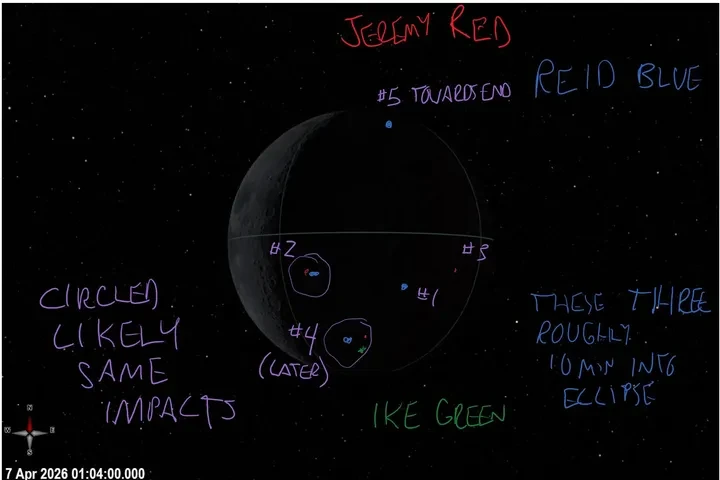
Even as the broader global research community prepares to dig into the full dataset, initial preliminary analyses have already yielded concrete, actionable results. The most definitive finding to date is the detection of five small, previously unrecorded meteoroid impact flashes on the lunar surface, captured by the Orion crew during a 54-minute total solar eclipse the craft passed through while in lunar orbit. Recording these faint flashes will drastically improve statistical estimates of how often centimeter-scale space debris strikes the moon — a critical data point for calculating long-term risks for future Artemis surface bases, crewed rovers, and astronauts conducting extravehicular activities.
Additional early observations include first-hand documented differences in color, brightness, and surface texture across distinct lunar geologic regions, which scientists are now cross-referencing with existing orbital composition maps to refine their accuracy. The crew also captured ultra-detailed imagery of the lunar terminator, the sharp dividing line between the sunlit day side and dark night side of the moon, that shows exactly how terrain visibility and shadow dynamics shift when the sun sits extremely low on the lunar horizon. These low-light, high-shadow conditions are the norm around the lunar south pole, NASA’s target landing zone for the upcoming Artemis III and IV crewed surface missions, so this dataset will help mission planners and future astronauts pre-emptively address navigation, lighting, and terrain recognition challenges before they even touch down.
This story was adapted from reporting originally published on WIRED en Español, translated from its initial Spanish release.