
Hunting Geoneutrinos 2 Kilometers Underground to Map Earth's Hidden Interior
This report was initially published in Quanta Magazine, the editorially independent Simons Foundation publication dedicated to expanding public access to cutting-edge math, physical science, and life science research updates.
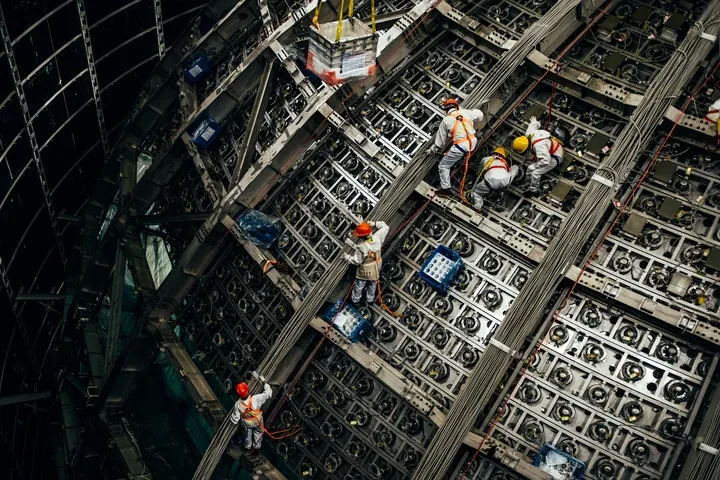
Two kilometers beneath the surface, buried deep in Ontario, Canada’s Creighton Mine at the SNOLAB underground physics facility, a crane slowly lowers detector technician Matt Depatie through a sealed hatch into a white-walled cavern holding 7,000 tons of ultrapure water. The liquid glows a vivid, windshield-wiper-fluid bright blue under the temporary work lights strung up for maintenance. "Splashdown," Depatie radios back to the surface the moment his boots land in an inflatable raft waiting on the water below.
This cavern is normally ranked among the darkest natural and manmade spots on the entire planet, but the temporary lighting gives a rare, unobstructed look at the otherwise hidden experimental space. I lean in over the hatch to watch Depatie paddle out to inspect the massive submerged instrument he’s there to service: a house-sized detector purpose-built to track down one of physics’ most notoriously evasive particles, the neutrino.
This is the SNO+ neutrino experiment, constructed around a 12-meter acrylic sphere lined with nearly 10,000 ultra-sensitive light sensors, and filled to capacity with 780 tons of oily liquid scintillator. The substance bursts into a tiny, distinct flash of light every time it is struck by a high-energy particle. The surrounding pool of ultrapure water, paired with kilometers of solid rock overhead, acts as a layered shield that blocks the overwhelming flood of disruptive cosmic radiation that would otherwise drown out the faint, rare flickers from far more unusual subatomic interactions.
Every step of our descent to the lab is designed to preserve near-total darkness, even outside the visible light spectrum. On the trip down the main mine shaft and through rough, rock-lined access tunnels, tiny radioactive radon dust particles stuck to our skin, hair, and street clothes. Before we could enter the controlled lab space, we had to discard all our standard mine workwear, take full decontamination showers, and change into matching electric blue coveralls and hairnets to minimize any radioactive contamination we could track inside. "These showers aren’t for your hygiene," Depatie joked as we changed, "they’re to keep the science clean."
These extreme precautions are standard practice for researchers chasing so-called "ghost particles": subatomic specks that could hold the key to unlocking long-hidden secrets of Earth’s unreachable deep interior. Neutrinos are the most abundant massive particle in the known universe, but their mass is infinitesimal, no more than a millionth of the mass of a single electron. With almost no heft and a neutral electromagnetic charge that lets them slip past regular matter almost entirely unimpeded, trillions of sun-generated neutrinos pass straight through every human body on Earth every second, leaving no trace behind. After decades of hunting these particles with detectors like SNO+, researchers have only managed to capture a few hundred thousand of their telltale faint flashes total.
Even more elusive are geoneutrinos, particles so rare that after decades of global searching, scientists had only detected a few hundred of them before 2025. Geoneutrinos form as a natural byproduct of the radioactive decay reactions that generate the heat that keeps Earth’s interior churning. That internal heat is the driving force behind mantle convection, the slow roiling of rock deep under the crust that powers everything from plate tectonics to the planet’s protective global magnetic field. Two separate sources contribute to that heat: leftover thermal energy from the planet’s initial formation 4.5 billion years ago, and the steady heat released as radioactive uranium, thorium, and potassium atoms decay in the rocks of the mantle and crust. Without that second, radioactive heat source, Earth would have cooled down completely billions of years ago, turning into a geologically dead, tectonically inert world.
By counting geoneutrinos directly, physicists can take the first ever unmediated measurement of how much of these heat-generating radioactive elements exist deep inside our planet. "This is the only project we run that is entirely focused on studying the Earth itself," explains Ryan Bayes, a particle astrophysicist at Ontario’s Queen’s University and long-time SNO+ collaboration member. "Nearly all our other work centers on signals coming to us from far distant corners of the universe."
The very first confirmed geoneutrino detection was published in 2005, captured by Japan’s KamLAND detector. Italy’s Borexino experiment followed up in 2009 with several dozen additional detections. Then in November 2025, the SNO+ team announced their own successful geoneutrino detection, boosting the total global count of observed particles by roughly 50. What makes SNO+’s milestone particularly groundbreaking is its location: these are the very first geoneutrinos ever measured in the Western Hemisphere, giving researchers a brand new vantage point to map the planet’s radioactive interior.
Huge gaps in understanding still remain when interpreting the data from these disparate detectors, but current preliminary results hint that each site is recording a very different geoneutrino flux. "This could be our first real hint that the Earth’s mantle is not uniformly mixed, like we long assumed," says Mark Chen, SNO+ collaboration director and particle astrophysicist at Queen’s University in Ontario. For decades, geochemists operated under the standard assumption that radioactive elements were spread evenly across the entire mantle, because the constant slow churning of convecting rock should stir everything into a uniform, well-mixed consistency. But the differing geoneutrino measurements from sites across three different continents now suggest that assumption may be wrong.
The areas that appear to produce the highest volumes of geoneutrinos sit almost directly above continent-sized blobs of unusually hot, ultra-dense rock that seismologists have mapped sitting on either side of the Earth’s outer core: these structures are formally called Large Low-Shear-Velocity Provinces, or LLSVPs, with one sitting under the African continent and the other under the Pacific Ocean. "There are deep mantle structures we still barely understand," Chen notes. "It’s very possible these huge dense masses are concentrated with high volumes of specific elements, including the radioactive isotopes that produce geoneutrinos." Neutrino detection could one day unlock the origins of these strange deep structures, and map the mantle flow patterns that underpin almost every major dynamic process in the Earth system. "This would let us build a full chemical map of the entire Earth’s interior, something we have never been able to do before," says William McDonough, leading geochemist at the Chinese Academy of Sciences and a decades-long pioneer in geoneutrino research.
Right now, the biggest open question is whether the measured differences in geoneutrino counts between different experiment sites reflect real variations in mantle composition under each location, or if the gaps come from differences in how each detector processes and counts valid geoneutrino signals. All researchers in the field agree that the margin of error is still too large to draw firm conclusions. "If we take the current results at face value, we could conclude the Western Hemisphere has far more radioactive material in its underlying mantle than the Eastern Hemisphere," McDonough explains, "but there are plenty of reasons to treat that preliminary claim with caution. Are the Japanese KamLAND readings correct? Are the Italian Borexino readings correct? Are both partially right, or is there an unaccounted-for error somewhere in one of the datasets?"
Bayes explains that a huge share of that uncertainty comes from the complex signal sorting process researchers have to run to pick out valid geoneutrino events from the noise. "These particles don’t show up with name tags that say ‘Hello, I’m a geoneutrino’," he points out. Teams have to systematically filter out signals from higher-energy particles, particles with the wrong helicity quantum property, and the flood of neutrinos generated by nearby nuclear reactors. They also have to subtract all geoneutrinos generated by radioactive decay in the Earth’s crust, the vast majority of which come from the few hundred kilometers of crust immediately surrounding each detector. Once all those other signals are stripped away, what’s left is the faint residual geoneutrino signal generated in the deep mantle.
Preliminary readings so far suggest the deep mantle geoneutrino flux is extremely high at the Borexino site in Italy, and unusually low at the KamLAND site in Japan, though the uncertainty bands for both measurements are still very wide. Chen notes that the full detailed geological analysis of SNO+’s results is still ongoing, but early readings show the mantle under the Canadian experiment falls somewhere neatly in the middle between the two extremes. SNO+’s team has an extra local challenge to work through when calibrating their readings: the geology immediately surrounding the detector sits in a 1.8-billion-year-old impact basin left by a massive ancient asteroid collision, a region still full of uncharacterized radioactive deposits. "There are still so many unknowns about this specific geological area," says Virginia Strati, University of Ferrara researcher who helped build the local radioactive background model for SNOLAB.
Additional uncertainty comes from global estimates of total heat output from radioactive decay in the mantle: current geoneutrino flux data suggests that radioactive elements could contribute anywhere from a tiny fraction of the mantle’s total heat to as much as 50% of it — a gap in output equivalent to the combined power of tens of thousands of large commercial nuclear reactors. Both layers of uncertainty make it extremely hard to pick out small real variations in mantle composition under different sites. "The difference between the geoneutrino flux we would expect from different distributions of radioactive elements in the mantle is very small, and right now it’s completely buried under our existing measurement errors," Strati says.
SNO+’s landmark detection lands right as the field of geoneutrino research is entering a major boom. JUNO, the massive next-generation neutrino experiment currently collecting data in southern China, is on track to release its first full geoneutrino flux measurement before the end of 2025, adding a fourth data point that promises to be far more sensitive than any prior detector. Buried under a mountain just outside the city of Guangzhou and filled with more than 20,000 tons of liquid scintillator, the JUNO experiment is so large that it is expected to capture more geoneutrinos in its first single year of operation than KamLAND, Borexino and SNO+ combined have detected over decades of running.
Researchers expect far more precise geoneutrino flux readings from all existing sites as they collect more data and pair their particle detection results with higher resolution local geological maps. But as McDonough points out, the ideal next step for the field is to build a large neutrino detector on the floor of the deep ocean, an idea he has advocated for over 30 years. An ocean-based detector would sit far away from thick, radioactivity-rich continental crust, on top of much thinner, far more geologically uniform oceanic crust. That would almost completely eliminate crust-related background uncertainty, leaving only the clear signal coming directly from the deep mantle. So far, the multi-hundred-million-dollar ocean detector concept has seen little funding support from national science agencies, but McDonough is optimistic the project could move forward in China, which has already greenlit a string of ambitious large-scale geoscience infrastructure projects. "It’s very much a feasible path right now," he says.
Until that ocean detector becomes a reality, physicists will keep paddling their rafts through 7,000 tons of ultrapure water, 2 kilometers underground, chasing faint flashes of light that could finally map the hidden depths of our own planet.