
The Theranos Hype Cycle: WIRED’s Unvarnished Retrospective of a Silicon Valley Grift That Fooled Us All
Elizabeth Holmes, the disgraced founder of fraud-plagued blood-testing startup Theranos, made her national media debut via a 2013 Wall Street Journal feature headlined A Drop of Blood, an Instant Diagnosis. Curiously, the piece never ran as a hard science or breaking business story — it landed in the paper’s Opinion section, penned by Pulitzer Prize-winning editorial board member Joseph Rago, who earned his accolades for sharp critiques of the Affordable Care Act. Rago gushed over the promise of giving patients far more direct control over their own healthcare, and cited no less an authority than former U.S. Secretary of State George Shultz (a sitting Theranos board member) who told him Holmes was poised to be the next Steve Jobs or Bill Gates.
By 2014, Holmes claimed the title of the world’s youngest female self-made billionaire, and the mid-2010s hummed with nonstop tech breakout wins: the iPhone’s cultural dominance, Tesla’s rapid rise, Airbnb’s hospitality disruption, and Twitter’s status as a global public square. I was on staff as an editor at WIRED back then, and the carefully curated version of Theranos presented to the public felt tailor-made for our publication’s brand. It read like proof that Silicon Valley’s signature innovation playbook could upend every stodgy legacy industry out there, even the heavily regulated world of medicine. For a magazine that popularized the very concept of the “quantified self,” Theranos’s sales pitch perfectly aligned with our long-held thesis that ordinary people could take full ownership of their health via cutting-edge tech and easy access to their own data.
My then-colleague Caitlin Roper, a fellow editor, spotted a compelling narrative in Holmes and her startup almost immediately — though no one on the team could pin down exactly what form the story should take. Our top executive editor suggested Roper fly out to the Valley to meet Holmes in person, dig up what details she could, and shape the piece from there. The end result was a widely shared longform Q&A titled One Drop, Infinite Data: How Elizabeth Holmes Built a Better Blood Test. But print magazine production runs move at the glacial pace of a post-Panamax cargo ship, so the feature didn’t hit newsstands until the March 2014 issue.
In the months that followed, other major publications piled onto the Theranos hype train. Fortune put Holmes on its cover. The New Yorker ran a lengthy profile. By October 2015, Inc. featured her on its front page, anointing her “the next Steve Jobs” — and just two weeks later, The Wall Street Journal dropped a bombshell investigative report from reporter John Carreyrou. Its seemingly mild headline hid explosive revelations: Theranos Has Struggled with Blood Tests. It turned out the company’s promises of near-instant, ultra-accurate micro blood testing were entirely fabricated, its proprietary breakthrough technology did not exist at all, and major retail partner Walgreens had already terminated its partnership agreement. The whole operation was a sprawling, high-stakes grift.
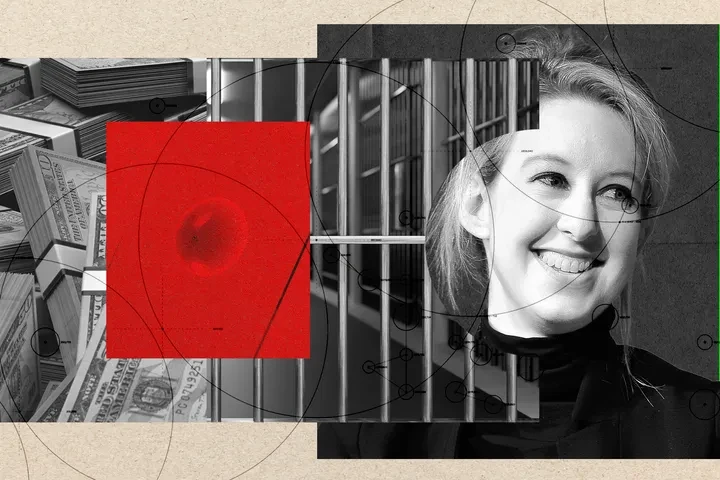
A new documentary out this week follows Holmes in the final weeks before she reported to prison to serve her fraud sentence. These days, when a group of former WIRED editors get together over drinks, it never takes more than one round before we start asking each other the same uncomfortable question: Did our publication help enable the ugliest parts of the tech industry’s decades-long march to unaccountable power? It sometimes feels like every eccentric, world-domination-obsessed billionaire with a government contract, who built everything from panopticon surveillance tools to unregulated artificial intelligence systems, made their first splashy media debut on our pages.
So when news of Holmes’ incarceration pushed the Theranos story back into the public eye, WIRED’s current leadership reached out to the old team to ask what on earth we were thinking back in 2013. It felt like a lifetime ago, so I called up Caitlin Roper, who now serves as Executive Editorial Director for Film, TV and Books at The New York Times.
“Like everyone at the magazine, I was chasing a great story,” Roper told me. “I was fascinated by this rare high-profile female founder, and the idea that her core mission was disrupting the broken U.S. healthcare system to drive more transparency and lower costs. I was going through a bunch of my own medical stuff at the time, getting stuck getting constant, annoying blood draws, so I was genuinely curious about what this technology could do for regular people.”
Roper got formal approval to report the piece, with the exact format left to be determined — in classic WIRED internal jargon, green light, format to come. We talked through the pitch together at length.
“I still remember that conversation we had, and I’ve thought about it a hundred times since,” Roper said. “We pulled up her board of directors, and the whole roster was completely batshit. It was stacked with retired military generals and senior former government officials, almost no one with actual experience in biotech or medical diagnostics. You pointed out how deeply weird that was, and it immediately set off all my alarm bells.”
A small group of us on the team did spot early red flags: Theranos had never published a single piece of peer-reviewed research on its technology, and we’d all heard unconfirmed, murky rumors of internal chaos and misconduct inside the company. But none of that meant there wasn’t a story worth telling; we just had to figure out how to cover it responsibly, we told ourselves. WIRED had admittedly been overly credulous of unproven scientific claims in years prior, but our core beat was always untested, futuristic-sounding innovation — and Theranos checked every single box for that brief.
“Looking back now, that whole period is dripping with dramatic irony,” Roper laughed.
Holmes agreed to the interview, so Roper drove down to Palo Alto to visit Theranos’ headquarters, only the second reporter ever granted full access to the office. She got the full, carefully staged performance that Holmes would become famous for delivering: she spoke exclusively in an unnaturally deep, artificially lowered voice, wore her signature Steve Jobs-style black turtleneck, and calibrated every movement and line of dialogue to project a specific larger-than-life image. (The original 2013 WSJ story ran with a stylized illustrated caricature of Holmes, while WIRED ran a professionally shot, heavily styled portrait of her in her iconic all-black uniform.)
They spoke for an hour, then Theranos staff pricked Roper’s finger to draw the tiny drop of blood for their test. “I asked if I could see their proprietary testing device, if I could follow my own sample through the lab to watch the process,” Roper recalled. “They immediately said no, absolutely not, and claimed it was a health and safety regulation issue.”
Instead, Holmes drove Roper over to the nearby Palo Alto Walgreens, one of the only locations where Theranos had even set up a tiny customer-facing booth. “That whole stop felt like an obvious snow job,” Roper said. “Even from my initial basic reporting, it was clear the service hadn’t rolled out to hundreds of stores across the Southwest like they were claiming, and the booth at that Palo Alto location wasn’t even open to customers.”
A few days later, Roper got her test results back. The panel of markers Theranos ran was almost identical to a standard blood test she’d gotten from her doctor right before the trip, and the numbers lined up perfectly. At the time, that felt like rough confirmation that the technology worked — we later learned Theranos had a fully stocked, standard commercial lab hidden in the back of its Palo Alto offices, and was running the samples on off-the-shelf diagnostic machines to fake the results.
When Roper drove back up to WIRED’s San Francisco headquarters after the trip, she realized there wasn’t enough concrete, verifiable detail to support a full reported feature. The Walgreens rollout hadn’t happened, and the company refused to let anyone independently test or examine their supposed proprietary technology. What Roper and the rest of the editorial team couldn’t crack, in hindsight, was independent third-party validation. We all knew a list of celebrity investor names and board members was no replacement for hard, peer-reviewed scientific proof. So Roper framed the whole piece as a no-frills conversation: a Q&A.
“It read like a fascinating profile of an unusual founder, more than a deep dive into a medical breakthrough,” she said. Roper asked Holmes every hard, critical question she could think of during the interview — every answer we got, we later learned, was a deliberate lie.
Roper openly acknowledges the blind spot that drew her to the story in the first place. “If Holmes had been a man, I would have been far less motivated to chase this story,” she admitted. “That was a huge part of what drew me in. I felt sympathetic to the way she’d curated her public persona and her weird, stiff affect, because I recognized that she was performing to fit into a deeply hostile, male-dominated Silicon Valley culture that forced women founders to overperform just to get taken seriously.”
It’s easy to try to frame this as a silly, overzealous DEI misstep — but that’s not the real story. Every single one of us at WIRED was actively pushing back against the rampant, well-documented sexism that defined both the tech industry we covered and our own newsroom. We kept asking ourselves: was Holmes’ wildly unorthodox board of all non-Silicon Valley figures a sign that biotech experts and VCs had already identified her as a high-risk fraud, or was it a sign that no Silicon Valley VC would even take a female biotech founder seriously enough to join her board? Just one month after Roper’s Q&A ran, a team of researchers from Harvard Business School and MIT Sloan published a study in the Proceedings of the National Academy of Sciences proving that investors were 60% more likely to fund the exact same startup pitch if it was delivered by a man instead of a woman — and conventionally attractive men had an even larger funding edge. Even today, 75% of U.S. venture capital partners are men, and that ratio was far worse a decade ago; multiple peer-reviewed studies have even found that male VC partners are far more likely to promote women to senior leadership at their firms if they have daughters, a sign of how deep the bias runs. Roper and the rest of the WIRED team were trying to push against that tide — and we accidentally ran headfirst into a con artist.
“Sure, it’s refreshing to cover a successful female founder for once, that’s a nice break from the usual bro startup stories,” says Dave Karpf, a George Washington University associate professor who has read every single back issue of WIRED and uses our archive to teach a class on Silicon Valley’s endless parade of utopian future visions. “But this wasn’t an untested, unproven new idea. This was an active, deliberate fraud. It’s totally plausible to imagine a timeline where WIRED dug in harder, took a more critical tone, and didn’t help amp up the hype cycle around Holmes.”
Roper agrees. “That story, and that glamorous portrait we ran of her, absolutely helped build her myth and draw even more positive attention to her,” she says. “I do feel partially responsible for that.”
To be fair, our Q&A was no more credulous than the glowing profiles every other major national outlet ran of Holmes around that time. And it’s not defensive to point out that even WIRED’s rigorous, multi-layered fact-checking process was never designed to unmask a years-long, coordinated, company-wide fraud. We all got fooled. Red flags are impossible to miss when you’re looking back at them in the rearview mirror.
Was it inherently absurd to believe a 19-year-old college dropout had cracked a breakthrough in pathology and microfluidics that no team of tenured biologists had ever managed? Of course. But as Karpf points out, the entire Silicon Valley ecosystem is built to celebrate that exact kind of iconoclastic, dropout outsider. Steve Jobs was a college dropout! Mark Zuckerberg dropped out! The entire industry’s founding mythos is built on that exact trope.
“If Holmes had actually gone and gotten a PhD in biochemistry, she never would have raised a hundred million dollars in funding,” Karpf says. “The VCs would have found some other charismatic outsider to sell them the fake story they wanted to believe. It’s the people who funded and promoted this nonsense who have the most explaining to do.”
Back in 2019, when Sam Altman stepped down from leading the Y Combinator startup accelerator to take the CEO role at OpenAI, he published a widely shared blog post praising the ideal founder’s “excess self-belief… almost to the point of delusion.” Venture capitalists will tell you openly they invest in founders just as much as they invest in ideas, and most of those ideas are half-baked, untested, and unfinished at the seed stage. The entire system actively encourages exaggeration, right up to the very line of outright deception. It actively selects for charismatic, high-performance hucksters. If your technology doesn’t quite work yet? That’s the most sacred Silicon Valley rule of all: fake it till you make it.
For decades, WIRED helped amplify that narrative. We ran endless features celebrating big, bold futuristic ideas — and sometimes those ideas turned out to be total duds. Sometimes we were far too early to the trend, sometimes we were just plain wrong. Our old story pitch process was basically a no-holds-barred Thunderdome where you fought to sell your narrative. Eventually, after Theranos, we built hard, non-negotiable editorial guardrails to bake skepticism into every step of the reporting process. For architecture and construction stories, a fancy render isn’t enough — the crew has to have broken ground on the physical site. Any physical, tangible product we cover has to exist in real, physical space; our reporters have to be able to visit it, touch it, test it themselves. A “flying car” we’re writing about actually has to, you know, fly. For every story covering new prescription drugs or medical diagnostic devices, we have a hard rule: if it hasn’t completed Phase 3 clinical trials, it doesn’t get published.
Today, every responsible tech journalist has had to build a new layer of armor to cover the future WIRED helped create. We can marvel at self-driving cars that navigate city streets like they’re piloted by ghosts, while openly acknowledging their frequent crashes, the fact that most of them are secretly remote-piloted by human operators thousands of miles away, and the urgent, unaddressed regulatory questions they raise. We can stand in awe of generative AI’s seemingly magical capabilities, while aggressively interrogating the exploitative training data and opaque business practices of the companies building the tools. And yes, the personal political spending of tech trillionaires matters — especially when they’re dropping a quarter of a billion dollars to lobby for a single political party’s agenda. All of that should have been standard operating procedure for WIRED back in the Theranos days. Now it’s a baseline expectation for every tech journalist on the beat.
The old guard of Silicon Valley hates that shift, predictably. Every so often, a grizzled 60-something Valley veteran who knows I spent most of my career at WIRED will corner me at a conference and complain, “What happened to that magazine? I miss the old, optimistic WIRED.”
But the March 2014 issue that ran Roper’s Theranos Q&A also featured a sharp, unsparing opinion piece from our colleague Bill Wasik, whose cover blurb was titled “Silicon Valley’s Douchebag Problem.” Wasik, now the science editor at The New York Times, wrote back then that the culture of unethical, single-minded profit chasing would erode tech’s cultural goodwill and kill its magical, utopian reputation. He warned that Peter Thiel-inspired ideas of tech secession and surveillance capitalism business models would spark a massive public backlash that would burn the entire industry to the ground. The Valley, he wrote, would eventually devolve into nothing more than a punchline: “a hallucination of a future that no one believes in anymore.”
Science and tech journalism can never just be puff pieces that celebrate investor returns and startup success stories. The future is far too high-stakes to treat it that way. The most gut-wrenching coda to this whole story is this: Joseph Rago, the WSJ editorial writer who wrote the very first glowing Theranos profile, got his own finger pricked at Holmes’ office during his reporting. He wrote that his full set of test results came back “by the time I walked out the door. (Phew: all clear.)” Four years later, 34-year-old Rago was found dead alone in his New York apartment. The city medical examiner ruled his cause of death sarcoidosis, a rare, hard-to-diagnose inflammatory disorder that is very rarely fatal. Doctors typically only diagnose it after ruling out every other possible condition. Rago never even knew he had it. But two of the most obvious biomarkers for the disease are elevated vitamin D levels and abnormal angiotensin-converting enzyme counts. A real, legitimate blood test almost certainly would have caught it.
Editor’s Note: This piece was updated October 20, 2026 at 1:10PM EDT to correct Caitlin Roper’s official job title at The New York Times. We welcome reader feedback — send letters to the editor to [email protected].